LIMITS OF ALGEBRAIC AND TRANSCENDENTAL FUNCTIONS
Up to now you have used algebra and geometry to solve problems where things are basically staying the same or changing at the same rate.
Calculus is a branch of mathematics that deals with things that are changing.
What is a limit?
One of the most basic and fundamental ideas of calculus is limits.
Limits allow us to look at what happens in a very, very small region around a point.
Two of the major formal definitions of calculus depend on limits
Definition of Limit of a Function
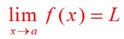
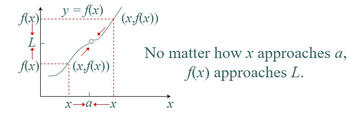
Suppose that the function f(x) is defined for all values of x near a, but not necessarily at a. If as x approaches a (without actually attaining the value a), f(x) approaches the number L, then we say that L is the limit of f(x) as x approaches a, and write
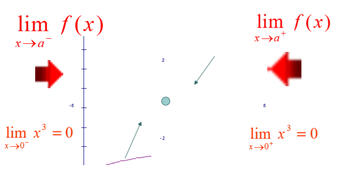
Left and Right Limits
Theorem
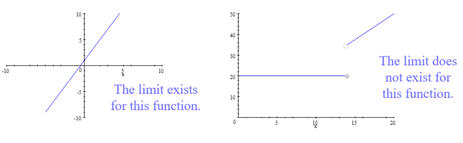
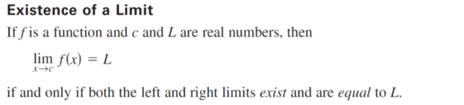
A function f(x) has a limit as x approaches c if and only if it has left-hand and right-hand limits there And these one-sided limits are equal:

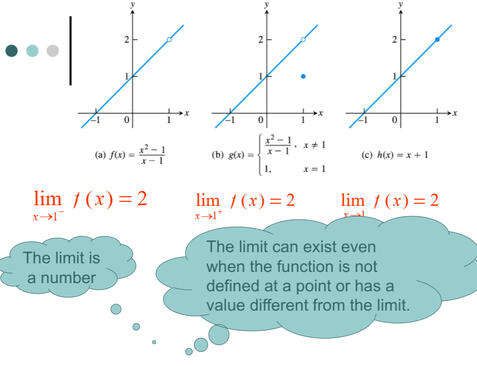
Examples
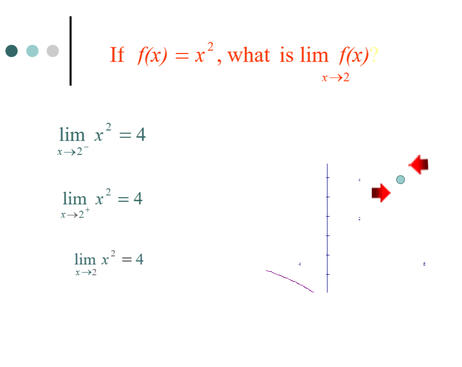
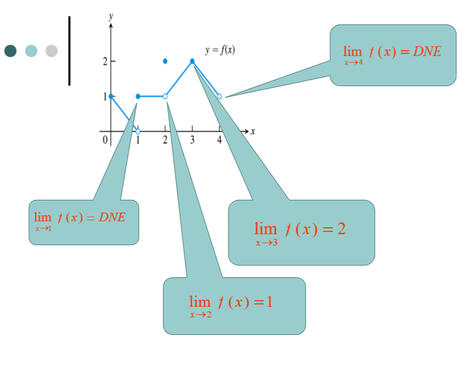
Techniques for evaluating limits
One-sided limits
You know that one way in which a limit can fail to exist is when a function approaches a different value from the left side of c than it approaches from the right side of c.
This type of behavior can be described more concisely with the concept of a one-sided limit.

examples
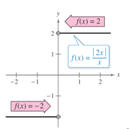
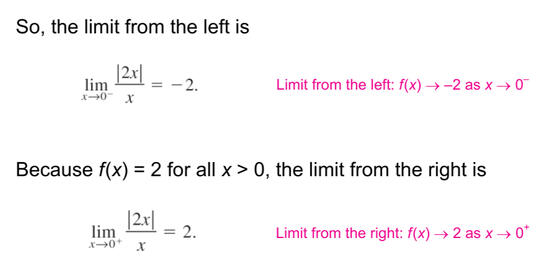
Find the limit as x → 0 from the left and the limit as x → 0 from the right for

Solution:
From the graph of f, shown to right,
you can see that f (x) = –2 for all x < 0.
limits of Algebraic functions
Algebraic expressions comprise of polynomials, surds and rational functions. For evaluation of limits of algebraic functions, the main strategy is to work expression such that we get a form which is not indeterminate. Generally, it helps to know “indeterminate form” of expression as it is transformed in each step of evaluation process. The moment we get a determinate form, the limit of the algebraic expression is obtained by plugging limiting value of x in the expression. The approach to transform or change expression depends on whether independent variable approaches finite values or infinity.
The point of limit determines the way we approach evaluation of limit of a function. The treatment of limits involving independent variable tending to infinity is different and as such we need to distinguish these limits from others. Thus, there are two categories of limits being evaluated :
(1) Limits of algebraic function when variable tends to finite value.(2)Limits of algebraic function when variable tends to infinite←click
limits of Transcendental functions
A transcendental function is an analytic function that does not satisfy a polynomial equation, in contrast to an algebraic function. In other words, a transcendental function "transcends" algebra in that it cannot be expressed in terms of a finite sequence of the algebraic operations of addition, multiplication, and root extraction.
Examples of transcendental functions include the exponential function, the logarithm, and the trigonometric functions.
A function that is not transcendental is algebraic. Simple examples of algebraic functions are the rational functions and the square root function, but in general, algebraic functions cannot be defined as finite formulas of the elementary functions.
Other examples←click
© Yanna Mamucud. All rights reserved.